Music Row In Nashville Tn


Music Row in Nashville TN is the roughly one-mile stretch centered on 16th and 17th Avenues South, where the city's record labels, publishers, and recording studios have clustered since the 1950s. It looks like a quiet residential neighborhood, but it is the actual business engine behind Music City's sound.
Music Row sits about one mile southwest of downtown Nashville, centered on 16th and 17th Avenues South (Music Square East and Music Square West), a short drive from Broadway's honky tonks.
The district traces back to 1954, when producer Owen Bradley converted a house on 16th Avenue South into a recording studio, kicking off the shift of the industry into this stretch.
Unlike Broadway, Music Row has almost no bars or live venues open to walk-in crowds; it is mostly record labels, publishing houses, law offices, and working studios.
Key landmarks include RCA Studio B, the Musica statue roundabout, Owen Bradley Park, and the former Quonset Hut studio, all walkable in under 30 minutes.
Nashville is projected to welcome 17.8 million visitors in 2026, with 11.8 million staying overnight, according to Visit Music City, and many first-timers skip Music Row entirely because it does not look like a typical tourist stop.
Guests staying at group rentals like Underwood Manor can reach Music Row in roughly the same 10 to 15 minute drive it takes to reach Broadway or the Country Music Hall of Fame.
If you have only heard of Music Row through country songs and liner notes, the actual neighborhood surprises most first-time visitors. There are no marquees, no lines, no cover charges. What you get instead is a low-slung grid of converted 1920s and 1930s houses, mid-century office buildings, and the occasional gravel parking lot where some of the most consequential recordings in American music history got made.
At Underwood Manor, we host bachelorette groups, birthday weekends, and country music fans every week who ask the same question after checking out Broadway on night one: "Where do we go to actually feel the music history?" The answer is almost always Music Row. We are about 5 minutes from Downtown Nashville and roughly 9-11 minutes from Music Row by car, which makes it an easy half-day add-on to any Nashville itinerary in 2026.
This guide breaks down what Music Row actually is, how it differs from downtown's tourist corridor, whether it is worth the visit, and how to explore it on foot without wasting your afternoon. We will also cover where the district sits relative to Broadway, the Country Music Hall of Fame, and the neighborhoods where most Nashville group rentals cluster.
What's the Difference Between Music Row and Downtown Nashville?
Music Row is an industry district of record labels, publishers, and recording studios, while downtown Nashville, especially Broadway, is the entertainment and tourism corridor of honky tonks, live music bars, and restaurants. Music Row is where songs get made; Broadway is where they get performed for tourists.
Geographically, the two areas sit about 2 to 2.5 miles apart. Music Row centers on 16th and 17th Avenues South, bounded loosely by Division Street, Demonbreun Street, and Grand Avenue. Downtown Nashville and Broadway sit closer to the Cumberland River, anchored by Bridgestone Arena, the Ryman Auditorium, and the Country Music Hall of Fame.
Functionally, the split matters more than the distance. Broadway is loud, lit up, and built for foot traffic, with three-story honky tonks like Tootsie's Orchid Lounge running live bands from early afternoon into the night. Music Row, by contrast, is largely quiet during the day, with parking lots outside publishing houses and recording studios that do not welcome walk-in visitors.
As a result, first-time visitors often lump the two together in their planning and end up disappointed when Music Row does not deliver a Broadway-style scene. Treat them as two separate stops: Broadway for nightlife, Music Row for history and photos. Guests based at Underwood Manor, roughly 5 minutes to Downtown and 7 minutes to Broadway, are well positioned to hit both without a long transit day.
Is It Worth Visiting Music Row, Nashville?
Music Row is worth visiting if you care about country and Americana music history, want a quieter alternative to Broadway's crowds, or want free, low-key photo opportunities away from tourist lines. It is not worth a special trip if you are only looking for bars, live shows, or shopping, since the district has very little of that.
The strongest case for visiting centers on RCA Studio B, the recording studio where Elvis Presley, Dolly Parton, and dozens of other major artists cut tracks starting in the late 1950s. Tours typically run through the Country Music Hall of Fame and require advance booking, since capacity is limited and the studio is a working historic site, not a walk-in museum.
Beyond the studio tour, the appeal is atmospheric. Owen Bradley Park offers a shaded, grassy spot with a bronze statue of the producer at his piano, a nice contrast to the concrete and neon of Broadway. The Musica statue, a large bronze sculpture of nine nude figures in a circle, anchors the roundabout at Division and Music Square and has become a genuine, if unofficial, photo landmark.
Where Music Row falls short: there is minimal shopping, almost no casual dining directly on the Row itself, and several blocks feel like a standard office park rather than a tourist attraction. If your group's main goal is nightlife or people-watching, spend that time on Broadway instead and treat Music Row as a 60 to 90 minute detour, not a full afternoon.

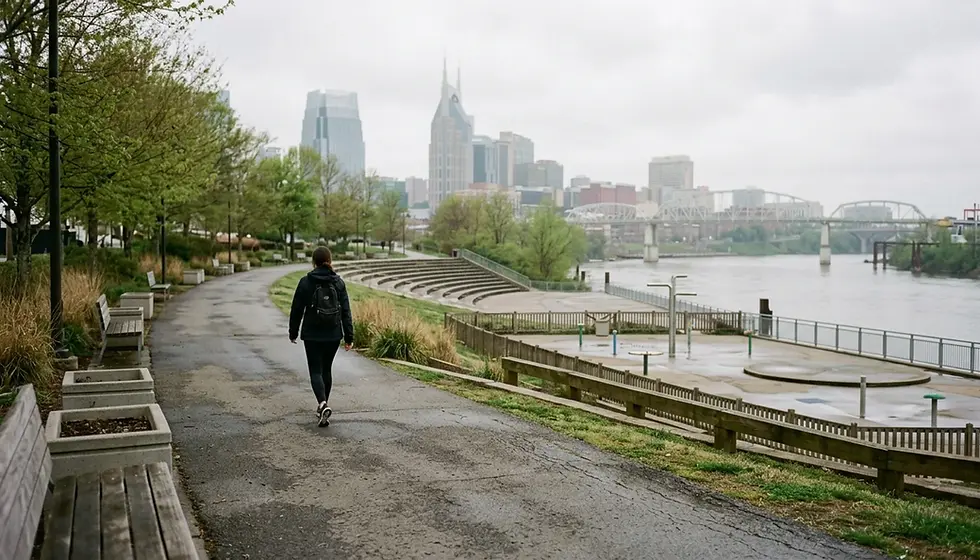
A trip down Music Row in Nashville TN
Can You Walk Music Row in Nashville?
Yes, Music Row is fully walkable, and walking is the best way to see it. The core district covers roughly a half-mile stretch along 16th and 17th Avenues South, meaning most of the key landmarks sit within a 15 to 20 minute walk of each other.
A practical self-guided route starts at the Musica statue roundabout, moves south down Music Square East past rows of publishing houses (many still marked with the label names on modest signage), swings through Owen Bradley Park for a rest stop, then continues to RCA Studio B near Roy Acuff Place. Budget 60 to 90 minutes for the full loop at a relaxed pace with photo stops.
Parking is the one genuine friction point. Street parking exists but is limited, and metered spots along Division Street and Demonbreun fill up during business hours on weekdays. Your best bet is to park near the Country Music Hall of Fame or a downtown garage and either walk the roughly 20 to 25 minute distance or take a short rideshare, since Music Row has no dedicated visitor parking lot.
For groups who do not want to navigate parking themselves, Old Town Trolley Tours includes Music Row as a stop on its hop-on hop-off route, which works well for larger parties or anyone visiting during Nashville's summer heat. Just note that trolley stops still involve walking once you are dropped off, since the buildings themselves are spread across several blocks.
What Is the Famous Music Street in Nashville?
Music Row itself, specifically 16th and 17th Avenues South, is Nashville's most historically significant music street, distinct from Broadway, which is famous for live music bars rather than the recording industry. The two are often confused by first-time visitors searching "famous music street Nashville," but they serve entirely different purposes.
Music Row earned its name in the 1950s when Owen Bradley moved his recording operation into a house on 16th Avenue South, followed quickly by Columbia Records, RCA, and a wave of publishing companies. By the 1960s, the stretch had become the physical and symbolic center of the country music business, a role it still holds in 2026 even as some label offices have shifted toward Wedgewood-Houston and other neighborhoods.
Broadway, meanwhile, earned its fame from honky tonks like Tootsie's Orchid Lounge and Robert's Western World, where live bands play multiple sets a day, mostly free to walk in. If someone says "famous music street" and means bars and nightlife, they mean Broadway. If they mean where the industry actually operates, they mean Music Row.
For visitors planning a trip, it helps to think of it this way: Broadway is where you go to hear music performed live. Music Row is where you go to see where recorded music history actually happened. Both deserve a spot on your Nashville things to do list, just on different nights or afternoons of your trip.
What Landmarks Should You See on Music Row?
RCA Studio B, the Musica statue, Owen Bradley Park, and the former Columbia Quonset Hut studio site are the four landmarks that define a Music Row visit. Each one tells a different piece of the district's story, from working studio to public memorial.
RCA Studio B, opened in 1957, is the most significant stop. Elvis Presley recorded more than 200 songs there, and Dolly Parton, Chet Atkins, and the Everly Brothers all worked sessions inside its modest brick walls. Tours run through the Country Music Hall of Fame and typically require reserving a combo ticket in advance, since group sizes are capped.
The Musica statue, installed in 2003 at the Division Street and Music Square roundabout, is the district's most photographed feature simply because it is visible from the street with no ticket required. Owen Bradley Park, a few blocks away, offers a quieter, shaded spot with a bronze statue of Bradley at a piano, a nod to the producer widely credited with building the modern Nashville sound.
The Quonset Hut, where Columbia Records built one of the first major studios in the area, still stands, though it now operates as a working facility rather than a public attraction. Notably, walking past these landmarks costs nothing beyond time and comfortable shoes, which makes Music Row one of the few genuinely free things to do in a city where most attractions charge admission.
What Businesses Actually Operate on Music Row Today?
Music Row today is a working commercial district of record labels, music publishers, entertainment law firms, performing rights organizations, and recording studios, not a retail or entertainment strip. Roughly 200 music-related businesses have historically clustered in the area, including offices for organizations like ASCAP and BMI.
Specifically, the mix includes major and independent labels, songwriting publishers who administer catalogs for working songwriters, and a scattering of hair salons, bars, and small restaurants that serve the industry crowd rather than tourists. This is a meaningful difference from Broadway, where nearly every storefront exists to serve visitors.
As a result, do not expect gift shops or walk-in tastings. What you will notice instead are unmarked buildings, modest signage, and gravel lots, since much of the real business happens behind closed doors in writers' rooms and mixing studios. This is part of what makes Music Row interesting to music fans: the low profile is authentic, not staged for tourists.
Additionally, some music industry activity has shifted toward neighborhoods like Wedgewood-Houston and The Gulch in recent years as commercial real estate on the Row has gotten more expensive. Still, Music Row remains the symbolic and functional center of Nashville's recording industry as of 2026, even as the broader footprint spreads.
How Far Is Music Row From Broadway and Downtown Nashville?
Music Row sits approximately 2 to 2.5 miles from Broadway and downtown Nashville, translating to roughly a 10 to 15 minute drive depending on traffic, or about a 40 to 50 minute walk if you prefer to cover the whole distance on foot. Most visitors drive, rideshare, or take a trolley tour between the two districts.
For groups staying at vacation rentals rather than downtown hotels, this distance is manageable but worth planning around. Underwood Manor, roughly 5 minutes to Downtown Nashville and 7 minutes to Broadway, sits on the west side of the city, putting Music Row within a similar 9 to 11 minute drive for guests who want to fit both stops into one day.
Rideshare costs between downtown and Music Row typically run in the $8-12 range each way, similar to what groups already budget for Broadway trips. During peak weekends like CMA Fest, when Nashville short-term rental occupancy jumped to 67.7% in 2026 according to Goodnight Stay Blog market data, expect surge pricing on rideshare apps and heavier foot and car traffic near both districts.
For groups already exploring nearby attractions, Underwood Manor also sits close to the Parthenon in Centennial Park and West End Avenue's restaurant row, both under 10 minutes away, making it a practical home base for a day that includes Music Row, downtown, and West End without excessive driving.

When Is the Best Time to Visit Music Row?
The best time to visit Music Row is on a weekday morning or early afternoon, when studio and publishing office parking lots are least congested and the streets are quiet enough to walk comfortably. Weekends offer a similarly calm atmosphere since the district is not a nightlife destination, but some businesses close entirely.
Spring (March through May) and fall (September through November) bring Nashville's most comfortable walking weather, with daytime temperatures typically in the 60s and 70s Fahrenheit. Summer visits are workable but plan for heat and humidity, especially if you are walking the full half-mile stretch between landmarks without much shade.
Avoid visiting during CMA Fest week in June if a quiet, uncrowded Music Row is your priority. Visitor volume across Nashville spikes significantly during that event, and while Music Row itself does not host CMA Fest programming directly, downtown traffic and parking pressure ripple outward across the whole city.
For groups combining a Music Row afternoon with a Broadway night out, aim to visit the Row between 10 a.m. and 2 p.m., then head downtown for dinner and honky tonks once the bars start filling up in the late afternoon. This sequencing avoids doubling back and lines up naturally with most group itineraries.
How Should You Plan a Music Row Visit Into a Nashville Trip?
Planning a Music Row visit works best as a half-day add-on to a longer Nashville itinerary rather than a standalone destination. Pair it with the Country Music Hall of Fame for the RCA Studio B tour, then use the rest of the afternoon to walk the district's landmarks before heading to dinner.
Book the RCA Studio B combo ticket in advance through the Country Music Hall of Fame, since tour times are limited and sell out on busy weekends.
Park near downtown or the Hall of Fame rather than trying to find street parking directly on the Row, since spots are scarce during business hours.
Walk the Musica statue to Owen Bradley Park stretch first, since it is free and requires no reservation, saving the studio tour for a fixed time slot.
Budget 90 minutes to 2 hours total for the full experience, including the guided studio tour and self-guided walking.
Combine with West End Avenue or Centennial Park if you are staying west of downtown, since both sit within a short drive of Music Row and offer dining options the district itself lacks.
Groups planning a bachelorette weekend or milestone birthday trip often ask whether Music Row fits the itinerary at all. It does, particularly as a Saturday morning activity before a bigger night on Broadway. Our Nashville bachelorette party planning resources cover how to sequence a full weekend, and Music Row slots in well as a lower-key morning stop before the group heads out for photos, brunch, and honky tonks later in the day.
Where Should Groups Stay to Explore Music Row and Broadway Together?
Groups exploring both Music Row and downtown Nashville benefit most from staying in a centrally located vacation rental rather than a hotel tied to one neighborhood, since a rental with parking and space to regroup makes it easier to bounce between the industry district, Broadway, and other attractions across a multi-day trip.
Underwood Manor is a rustic modern farmhouse sleeping up to 10 guests across 3 bedrooms, with a 7-person hot tub, a moody speakeasy game room featuring an 8-foot slate pool table and custom whiskey barrel bar, and a private backyard with a smokeless fire pit. It sits about 5 minutes from Downtown Nashville and 7 minutes from Broadway, with Music Row roughly 9 to 11 minutes away by car, making it a workable base for a day that covers both districts. One guest, Geralyn, wrote that the property is "5 mins or less to downtown in a peaceful neighborhood with an outstanding back yard," which matters if your group wants a quiet reset after a busy day of walking Music Row and touring studios.
For groups who want private en-suite bathrooms for every bedroom, The Herman Haven sleeps up to 10 guests with a boho-chic design, a 7-person hot tub, and a fully fenced backyard, located less than 2 miles from Broadway. It is also one of the few pet-friendly and wheelchair-accessible group rentals in the Nashville market.
If your crew wants to be within walking distance of Broadway's honky tonks and skip driving altogether for nightlife, Luxe Cowgirl sits just 3 blocks from Broadway with a saltwater resort-style pool, sky lounge, and fitness center, sleeping up to 8 guests across 2 king bedrooms. Its sister unit, Luxe SoBro, is a 1-bedroom condo for up to 4 guests with the same walkable Broadway location, ideal for couples visiting for a country music weekend that includes a Music Row afternoon.
Larger groups planning a combined bachelorette and bachelor celebration should look at the Ultimate Bach Pad, two side-by-side duplex homes sleeping up to 24 guests with 2 rooftop decks, 2 hot tubs, and 3 game rooms, located 8 to 10 minutes from Broadway. And for groups of up to 12 who want a rooftop deck with skyline views alongside a private hot tub, Fern Unit A and its sister property Fern Unit B can be booked together for a full 24-guest weekend, each 7 to 10 minutes from Broadway.
Deep Dive: Why Did Music Row Become Nashville's Music Industry Hub?
Music Row's rise traces to a specific decision in 1954, when producer Owen Bradley converted a residential house on 16th Avenue South into a working recording studio, later adding a Quonset-style building behind it that became one of the most productive studios of the era. Columbia Records followed with its own Quonset Hut nearby, and by the early 1960s the two blocks had become the gravitational center of country music production.
What made the location work was proximity and affordability. The area was residential and comparatively cheap in the 1950s, close enough to downtown for musicians and executives to commute easily, but far enough removed that studios could operate without downtown's foot traffic and noise. As labels like RCA followed Bradley's lead and opened Studio B in 1957, the neighborhood's identity solidified: houses turned into offices, garages turned into echo chambers, and the street grid itself, 16th and 17th Avenues South, Music Square East and West, took on names that reflected the new industry.
By the 1970s and 1980s, publishing houses, entertainment attorneys, and performing rights organizations like ASCAP and BMI had established a permanent presence, creating the dense concentration of music-business infrastructure that still defines the Row today. This is a meaningfully different history than Broadway, which grew from a working-class commercial strip into a tourist-driven entertainment district largely in the decades since the 1980s and 1990s.
In recent years, some label and publishing activity has spread toward Wedgewood-Houston and other adjacent neighborhoods as commercial rents on Music Row itself have climbed, a trend reported in local coverage from outlets like the Nashville Scene. Even so, the symbolic weight of "Music Row" as a place name has not transferred elsewhere, and the district remains the address most associated with Nashville's recording industry heritage as of 2026.
Practical Guidance: Common Mistakes When Visiting Music Row
The most common mistake visitors make is expecting Music Row to resemble Broadway, with bars, live music, and foot traffic. Music Row is quiet, largely residential in appearance, and closes down after business hours, so arriving in the evening or expecting nightlife will leave you disappointed.
Not booking the RCA Studio B tour in advance: tours run through the Country Music Hall of Fame and have limited capacity, especially on weekends.
Trying to find parking directly on the Row: street parking is genuinely limited during business hours. Park downtown or near the Hall of Fame and walk or rideshare instead.
Underestimating walking distance: the district spans roughly half a mile, and covering all four major landmarks on foot takes 60 to 90 minutes at a relaxed pace.
Visiting during peak summer heat without shade planning: much of the walking route has limited tree cover, so bring water and consider a morning visit in July and August.
Assuming it is a shopping or dining destination: it is not. Plan your meals for West End Avenue, The Gulch, or downtown instead.
One more overlooked detail: Music Row is not accessible by Nashville's WeGo bus system in a way that makes it convenient for most visitors, so budget for rideshare or a short drive rather than counting on public transit. For a broader look at Nashville logistics and planning, our things to do in Nashville guide covers transportation options across the whole city, and our month-by-month guide to Nashville weather and crowds can help you pick the right week for a quieter visit.
Frequently Asked Questions About Music Row in Nashville
Is Music Row the same as Broadway in Nashville?
No. Music Row is an industry district of record labels, publishers, and studios centered on 16th and 17th Avenues South, while Broadway is the downtown entertainment strip known for honky tonks and live music bars. They sit about 2 to 2.5 miles apart and serve completely different purposes for visitors.
How long does it take to see Music Row?
Plan for 60 to 90 minutes to walk the district's main landmarks, including the Musica statue and Owen Bradley Park. If you add the RCA Studio B guided tour, budget 2 hours total, since the tour itself runs separately and requires a reserved time slot through the Country Music Hall of Fame.
Do you need a car to visit Music Row?
You do not need a car once you arrive, since the core district is walkable within about a half-mile stretch, but getting there typically requires driving, rideshare, or a trolley tour, as Music Row is roughly 2 to 2.5 miles from downtown and not well served by Nashville's public bus routes.
Is RCA Studio B open to the public?
Yes, but only through guided tours booked in combination with a Country Music Hall of Fame ticket. Walk-up access is not available, and tour times fill up during busy weekends and CMA Fest week, so reserve in advance if visiting the studio is a priority for your trip.
What is the best neighborhood to stay in for visiting both Music Row and Broadway?
A rental within 5 to 10 minutes of both downtown Nashville and Music Row works best for groups who want to explore both areas without long drives. Properties like Underwood Manor, about 5 minutes to downtown and 9 to 11 minutes to Music Row, are positioned to cover both districts in one day.
Are there restaurants or bars on Music Row itself?
Very few. Music Row is primarily offices for record labels, publishers, and entertainment attorneys, with only a handful of restaurants and bars scattered through the district. Most visitors plan meals for West End Avenue, The Gulch, or downtown Nashville instead, since dining options directly on the Row are limited.
Is Music Row safe to walk during the day?
Yes, Music Row is a low-traffic, primarily commercial and residential district that is generally comfortable to walk during daytime and early evening hours. Since it is not a nightlife destination, the area is quiet after business hours rather than busy, which some visitors find calmer than downtown's crowded sidewalks.
How does Music Row compare to the Country Music Hall of Fame?
The Country Music Hall of Fame is a downtown museum with exhibits, memorabilia, and the RCA Studio B tour booking desk, while Music Row is the actual outdoor district where studios and label offices are located. Many visitors treat the Hall of Fame as the starting point before walking or driving to Music Row itself.
Final Take on Visiting Music Row in Nashville
Music Row in Nashville TN rewards visitors who understand what it actually is: a working, mostly unmarked industry district, not a second Broadway. If you come for the RCA Studio B tour, the Musica statue, and a quiet walk through the streets where Owen Bradley, Elvis Presley, and Dolly Parton made recording history, you will leave with a far deeper sense of Music City than Broadway alone can offer.
Plan a weekday morning or early afternoon visit, book the studio tour ahead of time, and park near downtown rather than searching for street spots directly on the Row. Nashville is projected to draw close to 18 million visitors in 2026, and the ones who add Music Row to their itinerary tend to come away with a richer understanding of how this city actually built its reputation as Music City. Pair it with a Broadway night, a stop at West End Avenue, and a comfortable home base, and you have a Nashville weekend that goes well beyond the honky tonk crawl.

If your group is planning a day that covers Music Row's studios and statues followed by a night on Broadway, Underwood Manor keeps the whole itinerary within a short drive, and the private backyard fire pit is the right place to unwind once you're back. Check availability here.
Written by Chase Gillmore, Owner at Underwood Manor
Content powered by inkSTR.co



Comments